
A bracket expected to be 50 mm long appears as 1,270 mm after import. The ratio is 25.4. That is a reason to investigate an inch/millimeter interpretation error, not proof that the model should immediately be rescaled.
NIST defines the inch as exactly 25.4 mm in its SI length reference. The calculations in this guide follow directly from that relationship. They are examples, not measurements of an uploaded file.
Start with a known length
Choose a dimension you can confirm from a drawing or from the authoring application. Compare the expected number, expected unit, imported number and imported unit. Record all four. “It looks huge” is not enough, because a viewer can fit almost any model to the screen.
| Expected | Observed | Ratio |
|---|---|---|
| 50 mm | 1,270 mm | 25.4 |
| 50 mm | About 1.9685 mm | About 1 / 25.4 |
| 50 mm | 50 mm | No scale difference for this check |
These ratios point to hypotheses. They do not rule out a transform elsewhere in a scene, a mistaken reference dimension or an intentional design scale.
Unit conversion and geometry scaling are different actions
Expressing one inch as 25.4 mm preserves the physical length. Treating the number 25.4 as inches instead of millimeters changes the interpreted length. Likewise, scaling coordinates can deliberately resize the design rather than simply change the display unit.
Inspect the export unit, receiving application unit and any import multiplier before altering geometry. Fix the earliest incorrect interpretation you can identify. Applying a second scale correction downstream can conceal the original setting and fail the next time the file is exported.
Area and volume do not use the length factor
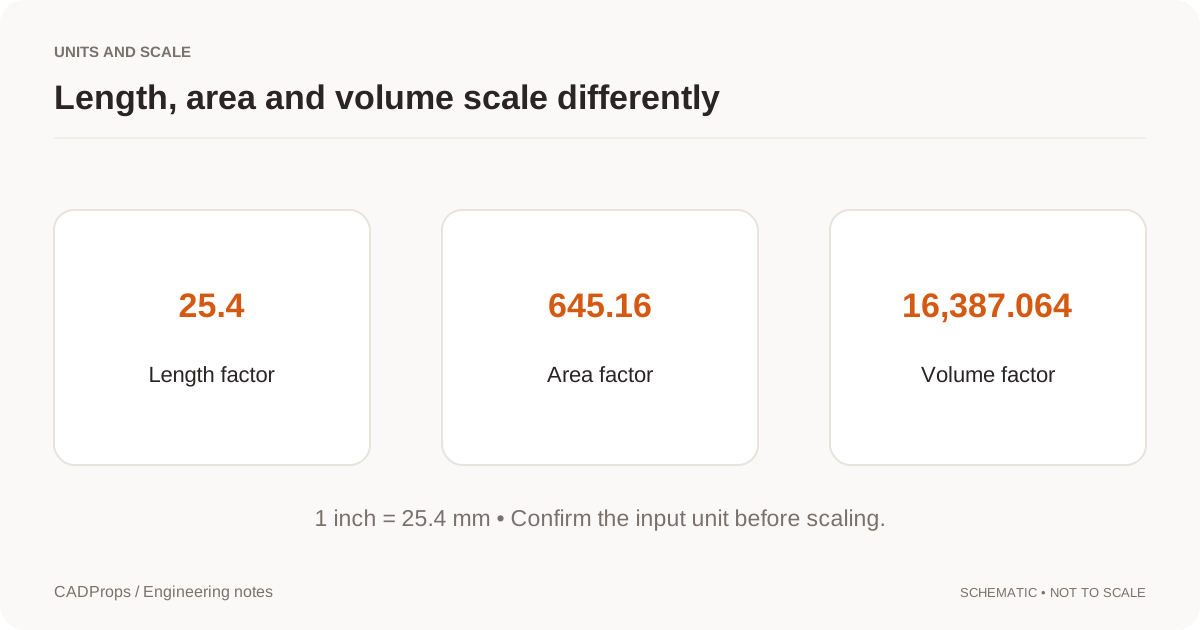
A length factor of 25.4 gives an area factor of 25.4², or 645.16, and a volume factor of 25.4³, or 16,387.064. Applying the length factor to an area or volume creates another error.
For another common example, 1 cm equals 10 mm, but 1 cm³ equals 1,000 mm³. An illustrative volume of 125,000 mm³ is therefore 125 cm³. At an assumed density of 2.70 g/cm³, that corresponds to 337.5 g. The arithmetic is valid only when the volume and density refer to the intended material and geometry.
Check the next application too
After correcting an export/import setting, reopen the output in the actual receiving workflow. Measure the known length again and record the unit. For a mesh handoff, do not rely on a filename such as part-mm.stl as the only unit instruction; communicate the intended scale and verify it after import.
Do not use automatic fit-to-screen as a test. It is a camera operation. Two models of very different physical size can occupy the same number of pixels on different viewers.
Keep the original and record the correction
Save the original unchanged. If a correction is necessary, record the factor, direction, reason and the software setting used. Confirm that each body or component has the intended transform. For assemblies, a correction applied only at one level may leave relative placement inconsistent.
CADProps processes self-contained STEP/IGES geometry, supported static meshes and bounded ZIP packages. STEP pairs support solid differences; other 3D inputs support visual comparison. DWG provides 2D previews when the reader is installed. Native CAD formats and downloadable model conversion are not available. Open the STEP workspace.