
A STEP model can look solid on screen and still produce no usable volume. The display renderer only needs enough geometry to draw surfaces. A volume calculation needs a suitable enclosed region and a consistent interpretation of its boundary.
Before pressing a repair button, distinguish three results: a valid numerical zero, an unavailable calculation and a failed geometry check. They should not share one empty-looking field in a report.
Find out what was actually imported
Inspect the body or entity list. Does the file contain solids, open shells, separate surfaces or only display data? Check the selected scope as well: a viewer can show several items while the property panel is measuring only one selected surface.
Do not infer a closed solid from shading. Rendering both sides of a surface can hide an opening. A cavity can also be legitimate; the question is whether the boundaries correctly define the intended material volume.
NIST's STEP tools separate visualization from inspection of file information and basic file errors. That is a useful distinction when troubleshooting a model that looks plausible but behaves unexpectedly. NIST STEP analyzer.
Check the common causes in a deliberate order
| Possible cause | Useful check | Safe response |
|---|---|---|
| No valid solid in the import | Body types and closure report | Request a solid export or inspect the open boundary |
| Wrong selection | Selected faces, shells and bodies | Re-run with a named, explicit scope |
| Missing assembly components | Reference and load status | Resolve the missing files first |
| Orientation or topology issues | Geometry validation output | Investigate the reported issue before editing |
| Unit interpretation problem | One known linear dimension | Confirm source and destination units |
This order avoids changing the model when the real error was a selection or a missing reference.
Understand the limits of a volume routine
A geometry kernel is not obliged to repair input before reporting a property. Open CASCADE's volume-property documentation notes requirements for closed boundaries and consistent orientation, and warns that invalid input can lead to wrong results. BRepGProp documentation.
That means a successful function call is not enough. The application needs separate validation and a result status. A negative, tiny or implausibly large value warrants investigation, not automatic conversion to an absolute value.
For a mesh-based estimate, also check whether the surface is closed and consistently oriented. Keep the method visible so that the result is not confused with a calculation from the original CAD geometry.
Repair is a controlled change, not a formatting step
Small boundary defects and tolerance issues may be repairable. Reconstructing a missing design surface is a different problem. A general “heal” command should not be assumed to know the designer's intended shape.
Open CASCADE describes a collection of specific shape-healing operations rather than a promise to reconstruct every damaged model. Shape Healing guide. Keep the original file, record the operation and compare the repaired result with the intended design.
Do not increase a sewing tolerance until the tool returns a solid and then stop checking. A larger tolerance can hide a problem by joining geometry that should remain separate. Recheck functional openings and mating regions after any repair.
Ask for a cleaner export when that is the better fix
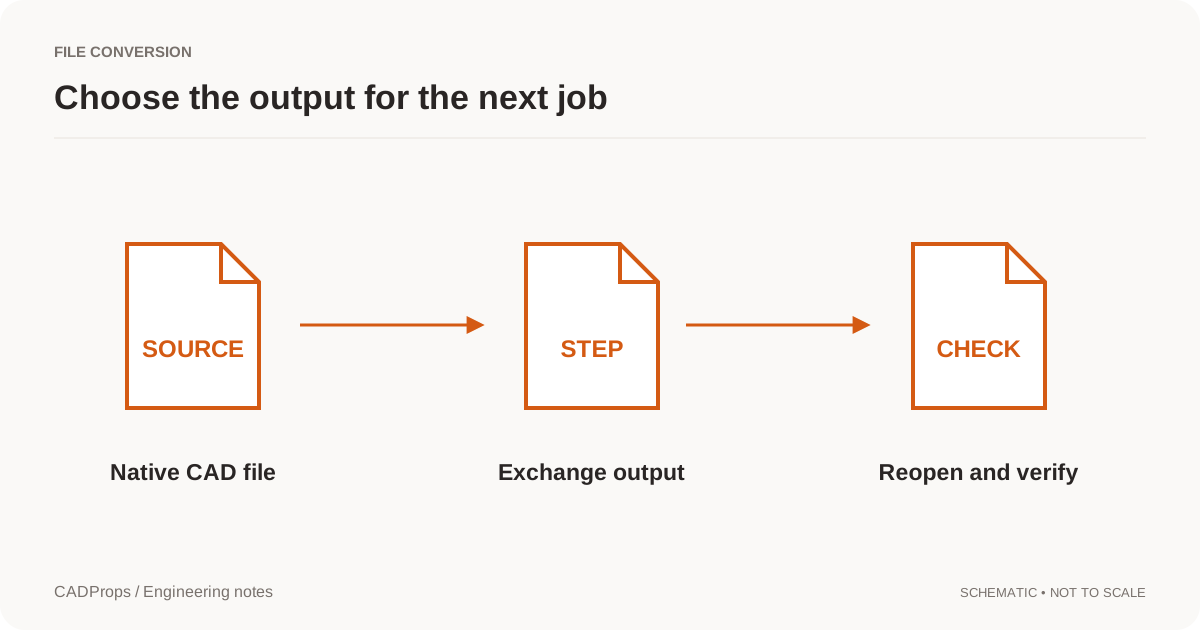
If the sender has the authoring model, requesting a new export can be more defensible than guessing at missing geometry. Ask for the intended configuration, resolved references and an agreed neutral format.
Describe the symptom precisely: “The received file contains open shells rather than a valid solid for this calculation” is more helpful than “Your STEP is broken.” Include a screenshot of the affected region and the validation message when you are permitted to share them.
Report uncertainty instead of hiding it
A useful property row might say: “Volume unavailable: open boundary detected; mass not calculated.” That is an honest result the next person can act on.
For batch work, keep the file in the report with a failure status. Do not drop it, insert a zero or silently substitute a bounding-box volume. A bounding box measures an envelope, not the amount of material in a part.