
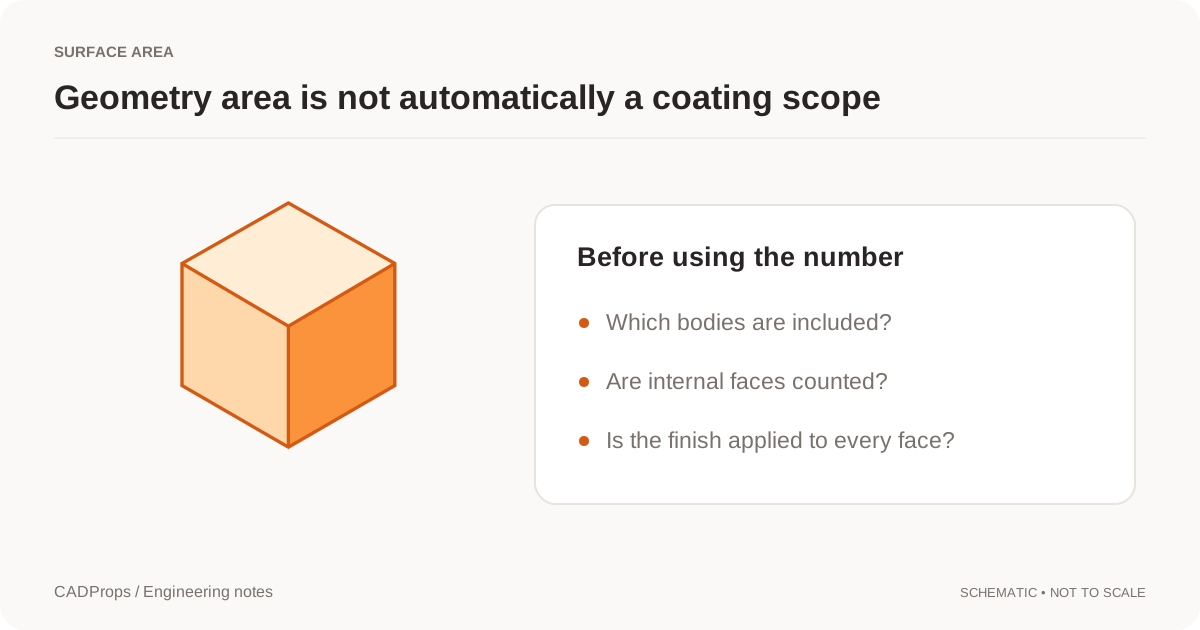
A model can have a well-defined geometric surface area and still be a poor basis for a coating estimate. The geometric question is “which faces were measured?” The manufacturing question is “which faces receive this operation?” Those scopes are not automatically identical.
Define the result before pressing calculate
State whether the result covers one selected face, one solid, all loaded bodies or an assembly. State whether repeated components are counted as instances or unique part definitions. Keep the area unit next to the number rather than leaving it only in a settings menu.
A useful report says “loaded exterior and interior faces of Body 1, mm²,” not simply “Area: 28500.” The latter makes it hard for another engineer to determine whether the number is appropriate.
Know the representation being measured
A reader may supply CAD surface geometry, a display mesh or saved properties from the source file. These are not interchangeable calculation paths. The Open CASCADE BRepGProp reference documents surface-property calculations and options that determine what is used. The product should report the path that actually produced the result.
A dense mesh can look smooth, but visual smoothness alone does not establish an area error bound. A coarse tessellation may be enough for a preview while being inappropriate for a particular measurement. Keep rendering settings and calculation settings distinct.
Interior surfaces and repeated geometry
A drilled hole has a wall. A hollow housing can have both internal and external surfaces. A full geometry total may include faces that will be masked, inaccessible or excluded from a finishing operation. Conversely, measuring only visible faces can miss faces that still need to be included.
Two touching components introduce another scope question: do you need the surface area of each manufactured part, or the exposed area of the assembled object? Adding individual part areas and measuring the exposed boundary of a union are different operations. Choose the interpretation for the task, not whichever gives the easiest number.
| Purpose | Scope to agree |
|---|---|
| Geometry report | Selected bodies, representation and units |
| Coating estimate | Faces included, masking and assembly state |
| Per-part purchasing table | Unique definitions versus component quantities |
| Model comparison | Identical scope and calculation settings for both inputs |
Check area units separately
One centimeter equals ten millimeters, so one square centimeter equals one hundred square millimeters. A geometric area of 28,500 mm² is 285 cm² or 0.0285 m². This is an arithmetic example, not a promised result for the housing illustration used on the site.
Do not reuse a volume conversion factor for area. Nor should a length-scale change leave the old area value attached to the file without a new calculation.
What to send with the number
Include the source identifier, relevant configuration, loaded body scope, units, calculation method and any unresolved components. For a coating task, attach the face-selection or masking instructions separately. A PDF screenshot alone may not identify all selected faces, especially hidden ones.
CADProps processes self-contained STEP/IGES geometry, supported static meshes and bounded ZIP packages. STEP pairs support solid differences; other 3D inputs support visual comparison. DWG provides 2D previews when the reader is installed. Native CAD formats and downloadable model conversion are not available. Open the STEP workspace.