

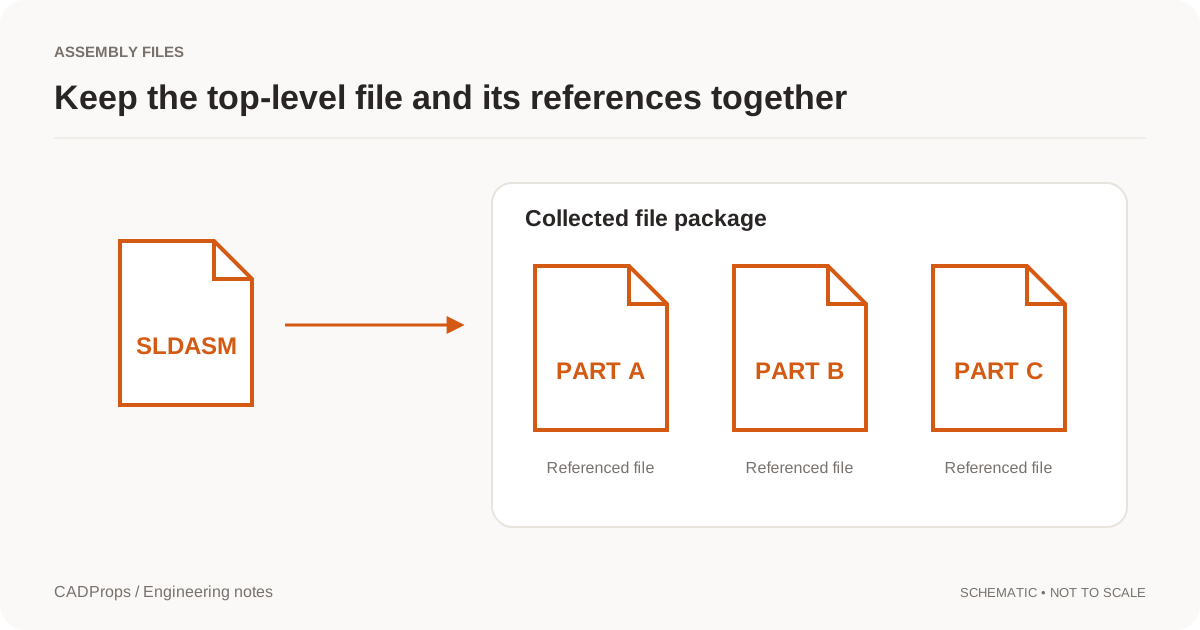
If an assembly opens as a few floating components, the viewer may not be the first thing to blame. The top-level assembly file can refer to part and subassembly files that were left behind. It can also describe a configuration in which some components are intentionally suppressed.
The useful question is not simply “Why is the model incomplete?” It is “Which components were expected, and are their definitions actually in the package?” Work through that question before flattening the assembly or trying random conversion settings.
Check the package before the geometry
Keep a copy of the received ZIP intact. Extract it into a new folder and inspect the file list. Look for the top-level assembly, referenced parts and nested subassemblies. Do not put all the contents into one flat folder unless the packaging workflow was designed for that change.
Two folders may each contain a different cover.sldprt. Flattening them can overwrite a file or make a reference ambiguous. Matching a filename is not enough to prove that a reader found the correct component.
An assembly reader may support external references, instances and configurations separately. The STEP data reference is an example of how these features are distinguished. Your chosen service must expose enough information to tell a missing reference from a component that is intentionally not loaded.
Ask the sender for a collected file set
SOLIDWORKS provides Pack and Go to gather related design files. Its documented workflow can collect referenced files into a folder or ZIP; the available options and menu locations depend on the installed release. Pack and Go overview and file-list options describe the purpose of that operation.
Ask the sender to open the intended assembly, resolve existing reference warnings, select the intended configuration and use the collecting workflow. They should inspect the resulting package before sending it. A ZIP made from only the top-level file has not solved the reference problem.
Include only what the handoff requires. Drawings, textures and simulation results may matter in some reviews and add unnecessary bulk in others. Agree the scope rather than assuming the smallest or largest archive is correct.
Separate four common symptoms
| Symptom | Check first | Avoid doing this |
|---|---|---|
| Components reported as missing | Referenced filenames and paths | Renaming files until the warning disappears |
| Some parts absent without an error | Configuration and suppression state | Declaring the assembly complete from its thumbnail |
| Identical-looking parts in wrong places | Instances and transforms | Deleting duplicates before understanding their role |
| Geometry present but colors missing | Appearance data and display support | Treating a color difference as a shape change |
A repeated bolt is not necessarily duplicated data. It may be one part definition used by several assembly instances. Quantities must follow the intended assembly structure, not a count of unique filenames.
Do not report a partial assembly as a complete one
An overall size for the loaded components may still be useful, but it needs a label. The same applies to volume and mass. A missing motor or plate can make the total look plausible while being wrong for the actual assembly.
Keep a visible list of unloaded components next to the result. If the system cannot resolve the expected configuration, stop the aggregate calculation or mark the scope as incomplete. A blank mass cell with an explanation is better than a precise-looking total for half the machine.
A neutral assembly can be a fallback, not a repair
The sender can also provide a STEP export of the resolved assembly. That may be sufficient for a geometry review, but check whether it retains components, names and placements in the way the receiving workflow needs. It does not replace missing native references for someone who must edit the original assembly.
Ask for both packages when the review spans design editing and external inspection. Keep their revision labels aligned, and do not silently mix a STEP export from last week with the current native assembly.
A short message that usually gets a better response
“Please resend the top-level assembly with all referenced parts and subassemblies, using the intended review configuration. Keep the folder structure in a ZIP and list any intentionally excluded components. We need the package that corresponds to revision B.”
That request gives the sender something to verify. Once the package arrives, reopen it from a clean location and compare the component list before continuing with batch processing.