

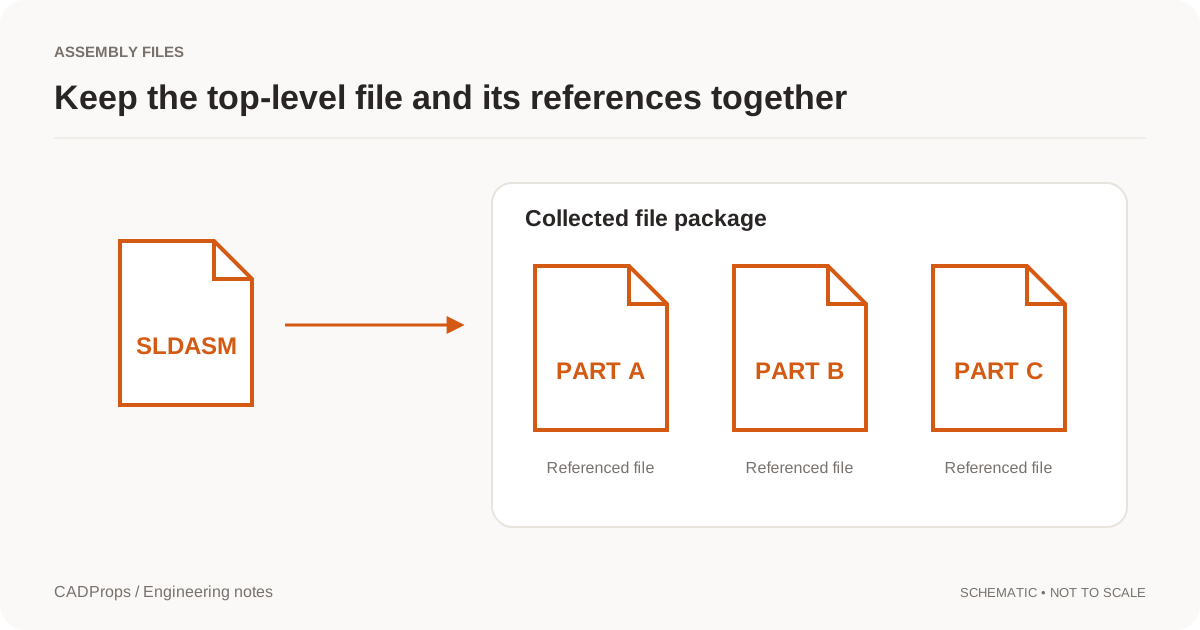
A .sldasm file is a SolidWorks assembly document, not a self-contained promise that every component is inside one file. If you only need to inspect an assembly, you do not necessarily need a SolidWorks installation. A compatible viewer can be enough, provided the assembly and the parts it references arrive together.
CADProps supports tested SolidWorks part and assembly inputs for browser viewing and STEP conversion. For an assembly, the important preparation step is packaging the root SLDASM with its referenced SLDPRT files and any nested assemblies. A model that opens with missing components is still incomplete even when the visible geometry looks plausible.
Use the SolidWorks viewer when the job is inspection. Use a compatible authoring workflow when you need to change mates, sketches, configurations or features in the original design.
Why a SLDASM may not open by itself
A SolidWorks assembly stores relationships between components. Those components are commonly separate .sldprt files or lower-level .sldasm files. Sending only the top-level assembly can therefore leave the receiver with references but no geometry for some parts.
SolidWorks provides Pack and Go specifically to collect related files for a model. The official help describes collecting referenced files into a folder or ZIP package; that is the safest handoff pattern when you control the source workstation. See SolidWorks Pack and Go.
If you received an isolated SLDASM from somebody else, do not rename it to STEP and do not fabricate empty files for the missing parts. Ask for a complete package or a neutral export from the released revision.
Open a SLDASM in a browser
- Open the SolidWorks viewer and check the current upload and retention limits.
- If the assembly has external references, upload a ZIP that contains the root SLDASM and all required SLDPRT or nested SLDASM files with their relative folders preserved.
- Wait for processing, then inspect the assembly tree before relying on the rendered image.
- Look for missing-component warnings. If any references are missing, treat the result as partial.
- Use Properties to check overall X, Y and Z extents and the loaded component structure.
- Measure one dimension you already know from the drawing or sender. A correct-looking thumbnail is not a unit or revision check.
- If you need a neutral exchange file, use the available STEP conversion and reopen the result in the receiving CAD system.
A browser viewer is useful for review, quoting and quick inspection. It does not reconstruct the complete SolidWorks feature history, mates or design intent that an editor needs.
Check completeness before checking mass
Assembly properties only make sense after you know which components were loaded. If a motor, bracket or purchased part is absent, the total volume and any density-based mass calculation describe the partial assembly, not the released product.
Use this order:
| Check | What it tells you |
|---|---|
| Assembly root | You opened the intended top-level SLDASM |
| Component count | The structure roughly matches the expected product |
| Missing-reference warnings | Whether some geometry was not supplied |
| Units and overall dimensions | Whether scale and orientation are plausible |
| One known measurement | Whether the loaded model agrees with a trusted reference |
| Volume and mass | Useful only after completeness and density assumptions are confirmed |
Do not use a calculated mass as a substitute for a bill of materials or material specification. CADProps calculates mass from loaded geometry and a user-selected density.
What to do when parts are missing
The most common SLDASM failure is not a rendering problem but an incomplete package. Read the missing SolidWorks assembly parts guide before trying random conversions.
If you can contact the sender, ask for one of these:
- a Pack and Go ZIP containing the released top-level assembly and all referenced files;
- a STEP export of the intended assembly if native editing is not required;
- the controlling drawing or revision information alongside the 3D model.
When the sender uses eDrawings for review, that is another official SolidWorks-family viewing route. Its supported behavior and limits should be checked against the exact file and release; see the eDrawings FAQ.
SLDASM versus SLDPRT
Use the file type to frame the question correctly:
.sldprtis a part document and is usually the simpler native handoff..sldasmis an assembly root and can depend on many other files.- a drawing is a separate document and may control dimensions, tolerances and revision information that the 3D assembly alone does not establish.
If you only received one part, read how to open SLDPRT without SolidWorks. If you received a complete assembly package, keep its folder structure intact.
Convert to STEP when the recipient needs geometry, not SolidWorks editing
STEP is often the cleaner handoff when the receiver needs geometry in another CAD system rather than the original SolidWorks design history. Before accepting the export, compare the converted assembly with the native source or controlling drawing.
Check the top-level dimensions, component count, orientation and at least one known feature. If the receiving software flattens names or structure, decide whether that is acceptable for the job before release.
For supplier workflows, the model should travel with enough context to identify the revision and intended use. The supplier CAD handoff checklist covers that process.
Open a SLDASM assembly when you have the complete package and know which revision you expect to see.
Original article: CADProps · https://www.cadprops.com/guides/open-sldasm-without-solidworks/