

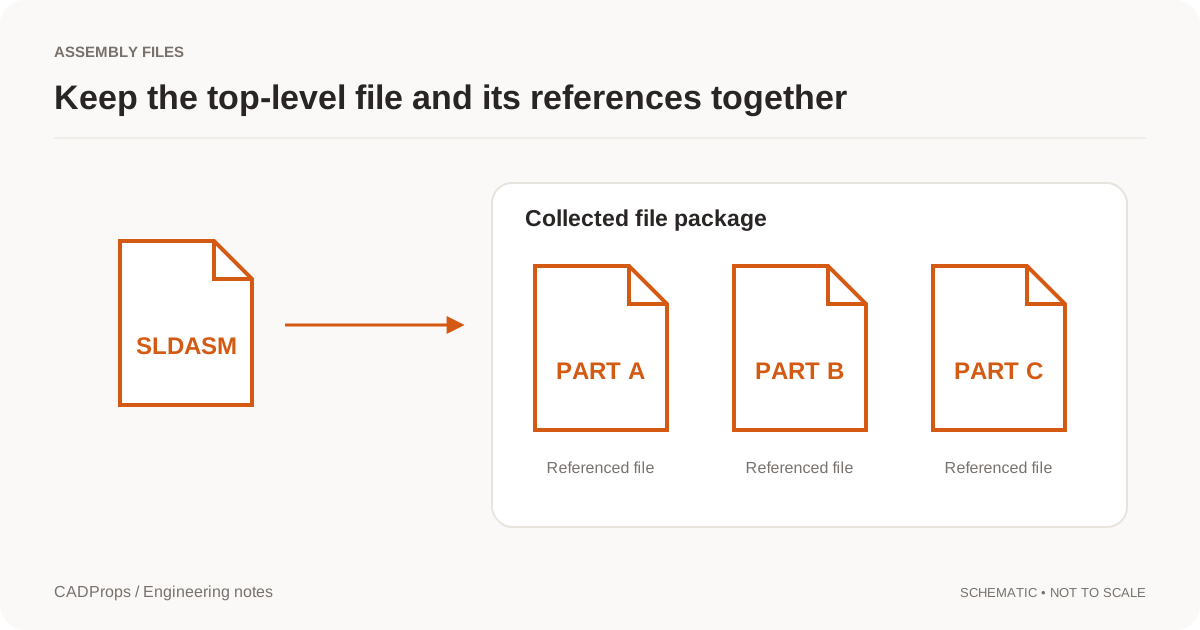
A CAD assembly is rarely one file. SolidWorks, CATIA, Inventor and similar systems store the assembly and its parts separately, then point from the assembly to those parts with relative paths. A ZIP is useful only when it preserves that structure.
Open the package in the ZIP viewer. If several models are present, choose the assembly root rather than a single part that happens to sit at the top of the archive.
Put the assembly and its parts in one archive
Include the root assembly and every component it references. Nested assemblies belong in the same ZIP, still in their own folders. Renaming the archive does not find parts that were left out.
Keep the relative folders the CAD system wrote. Moving every file into one flat directory breaks references that use a path such as parts/bracket.sldprt. SolidWorks documents this kind of package in Pack and Go; other systems have their own pack command. Use that command when you have it, then zip the result without rearranging it.
What this viewer will not open
The package is limited to 50 entries and 100 MiB after expansion. Encrypted archives, nested ZIPs, symlinks, paths that climb out of the archive, and links to remote files are rejected. A glTF scene can be packaged with its local buffers and images; remote texture URLs are not fetched.
Choose the root when the ZIP contains more than one model
An archive of a machine often contains the top assembly, subassemblies and parts. Opening an arbitrary part shows that part, not the machine. Select the root assembly the sender named.
Missing components produce a warning when some geometry still loads. Dimensions, volume and mass then describe the loaded geometry only. They are not the complete assembly. The same rule is covered for SolidWorks assemblies, CATIA products and Inventor assemblies.
Check the package before you convert it
- The expected root model is selected.
- The warning list is empty, or every missing name is understood.
- One known dimension matches the drawing or the sender's note.
- Component placement looks like the intended assembly, not a pile of parts at the origin.
After that, convert only if the next system needs a different format. Use the conversion checklist on the output. A successful conversion of an incomplete ZIP is still an incomplete model.
Original article: CADProps · https://www.cadprops.com/guides/zip-packaged-cad-models/