

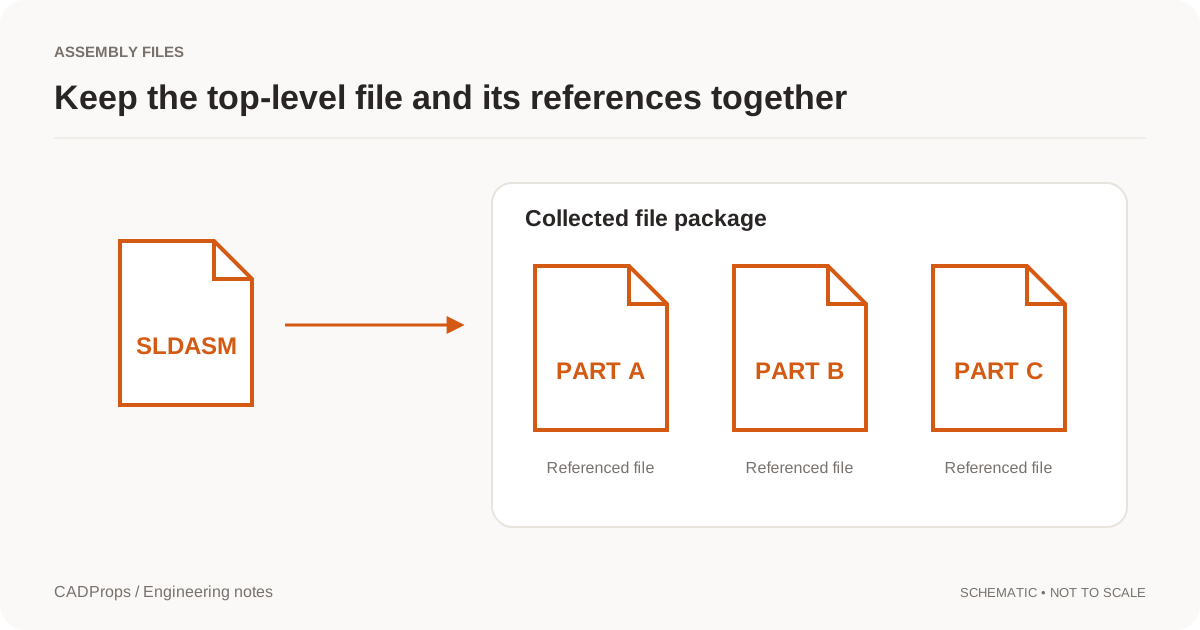
A CATProduct assembly can open with missing components even when the top-level product file is valid.
CATProduct can reference separate CATPart files and nested product content. If those files are missing or moved, the visible assembly becomes partial.
Treat missing components as a package-completeness issue before trusting dimensions, volume, mass or conversion output.
Why CATProduct references break
Typical causes include:
- only the root CATProduct was sent;
- CATPart dependencies were omitted;
- nested product files are missing;
- folders were flattened or renamed;
- duplicate filenames became ambiguous;
- files were collected from different revisions;
- original references point outside the delivered folder tree.
The assembly file cannot supply geometry that exists only in absent CATPart files.
Keep the missing-reference list
Record every unresolved component name or path.
Send that list back to the CATIA owner and request the exact dependencies from the same release.
Do not substitute a same-named CATPart from another folder or revision unless identity is verified.
A replacement can remove the warning while making the assembly incorrect.
Preserve source folder structure
When creating the ZIP, keep the relative directory layout.
Flattening the package can break product links and can create ambiguous duplicate filenames.
The safest handoff is a collected package from the CATIA project/release rather than a manually assembled set of files from several locations.
A partial product can still look plausible
Outer housing components may load while internal parts are absent.
The bounding dimensions may remain almost unchanged.
The viewer may still calculate area, volume or mass for what loaded.
Those values are partial.
Keep incomplete status beside every derived property.
Check revision consistency
A CATProduct from one revision can reference CATPart names or structures that differ from another revision.
Mixing files may cause both missing references and subtle wrong-part substitutions.
Ask for one coherent released package.
Record the revision or issue label with the ZIP.
STEP conversion does not recover missing CATParts
If you convert a partial CATProduct to STEP, the neutral file is also partial.
Before using the CATIA to STEP converter:
- resolve missing references;
- confirm intended product root;
- verify units;
- compare expected components;
- then convert.
Reopen the STEP and verify assembly scope again.
If the original dependencies are unavailable
Document what is missing and what the visible result contains.
Do not estimate complete assembly totals from the partial geometry.
If the source CATIA environment can still open the intended product, request a fresh STEP export from the released configuration.
That can provide a complete neutral snapshot even when reconstructing native references is difficult.
A practical repair sequence
- Preserve the received package.
- Record missing CATPart/product references.
- Request the exact files from the same release.
- Restore relative folders.
- Upload the corrected ZIP.
- Confirm missing-reference warnings disappear.
- Recheck dimensions and component scope.
- Only then use total properties or STEP conversion.
A complete assembly is established by resolved product structure and verified scope, not by how convincing the rendered image looks.
Original article: CADProps · https://www.cadprops.com/guides/catproduct-missing-parts/