

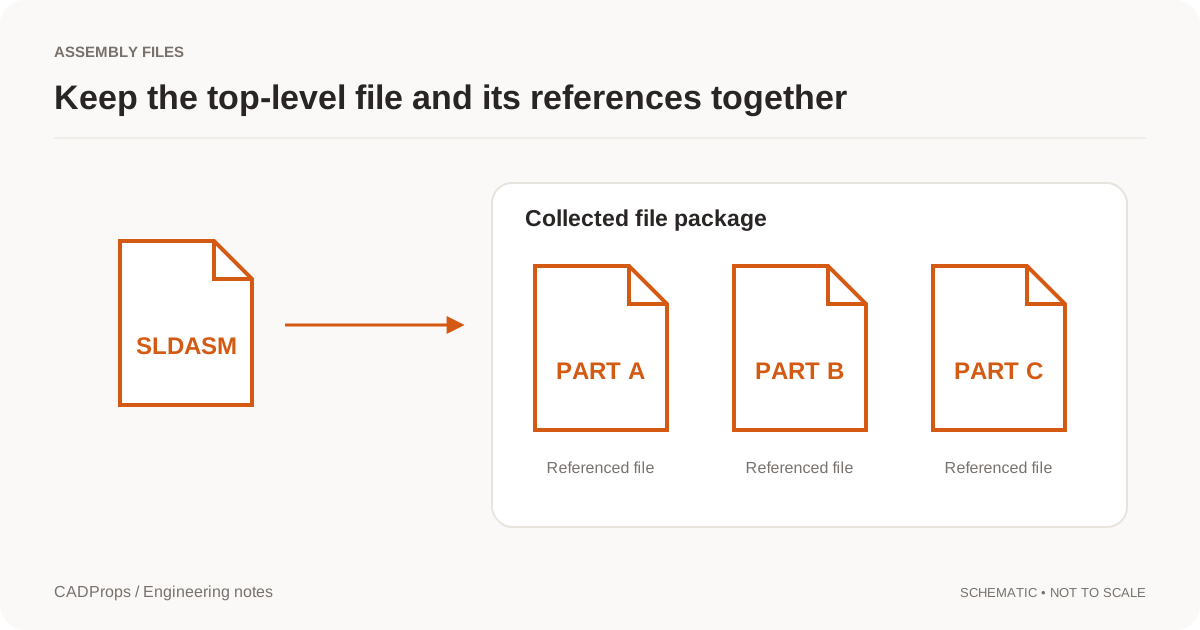
An Autodesk Inventor IAM can open with missing components even when the top-level assembly file itself is valid.
The usual reason is that referenced IPT parts or nested IAM subassemblies were not included in the handoff, were moved, or no longer exist at the expected relative paths.
Treat this as a package-completeness problem before treating it as a geometry problem.
Why IAM assemblies lose components
Common causes include:
- only the root IAM was sent;
- referenced IPT files were omitted;
- nested IAM subassemblies are missing;
- folder structure was flattened;
- duplicate filenames became ambiguous;
- files were mixed from different revisions;
- source references point outside the collected folder.
A viewer cannot recreate component geometry that was never supplied.
Record the missing-reference list
When processing reports unresolved components, keep the filenames or paths.
That list is much more useful than a generic "assembly incomplete" message.
Send it back to the CAD owner and ask for the missing files from the same revision.
Do not replace a missing component with a same-named file from another project unless the source/revision is verified.
Preserve relative directories
Inventor project structure can matter.
When creating a ZIP, preserve the folders used by the collected assembly package.
Flattening directories can break references or create filename collisions.
Keep the root IAM, nested IAM files and IPT parts in the layout provided by the source workflow.
Partial assemblies can still look correct
An IAM missing internal components may retain the same outer envelope.
That means:
- X/Y/Z dimensions can look plausible;
- a rendered screenshot can look convincing;
- some volume/mass can still be calculated.
Those values describe only loaded geometry.
Do not present them as complete assembly totals.
Rebuild from one released package
Mixing revisions is risky.
A new root IAM can expect parts that do not exist in an older component folder. An old root can load new parts that fit but do not belong to that release.
Ask the sender to collect the assembly from one known design state or project revision.
Keep revision context with the ZIP.
Convert only after completeness is understood
Converting IAM to STEP does not restore missing IPT files.
A partial native package produces a partial neutral result.
Before using the Inventor to STEP converter:
- review missing references;
- restore dependencies;
- verify units;
- check expected component scope;
- then convert.
Reopen the STEP and confirm the same assembly scope.
If missing components cannot be recovered
Document exactly what loaded and what did not.
Avoid guessing total mass, volume or BOM completeness.
If the Inventor authoring environment can still open the full assembly, request a fresh STEP export from the released configuration.
That may be safer than trying to reconstruct an old dependency tree manually.
A practical repair sequence
- Keep the received ZIP unchanged.
- Record missing IPT/IAM references.
- Request those files from the same revision.
- Restore relative folders.
- Upload the corrected package.
- Confirm warnings disappear.
- Recheck assembly dimensions and scope.
- Only then use total properties or conversion.
The goal is to rebuild the intended assembly, not just silence the missing-file warning.
Original article: CADProps · https://www.cadprops.com/guides/iam-missing-parts/