
You do not need Autodesk Inventor installed just to inspect a readable .ipt part. A compatible native-file viewer can display the geometry; CADProps supports tested IPT inputs for browser inspection and STEP conversion. File version and usable geometry still matter. Viewing a part does not restore its original parametric editing workflow.
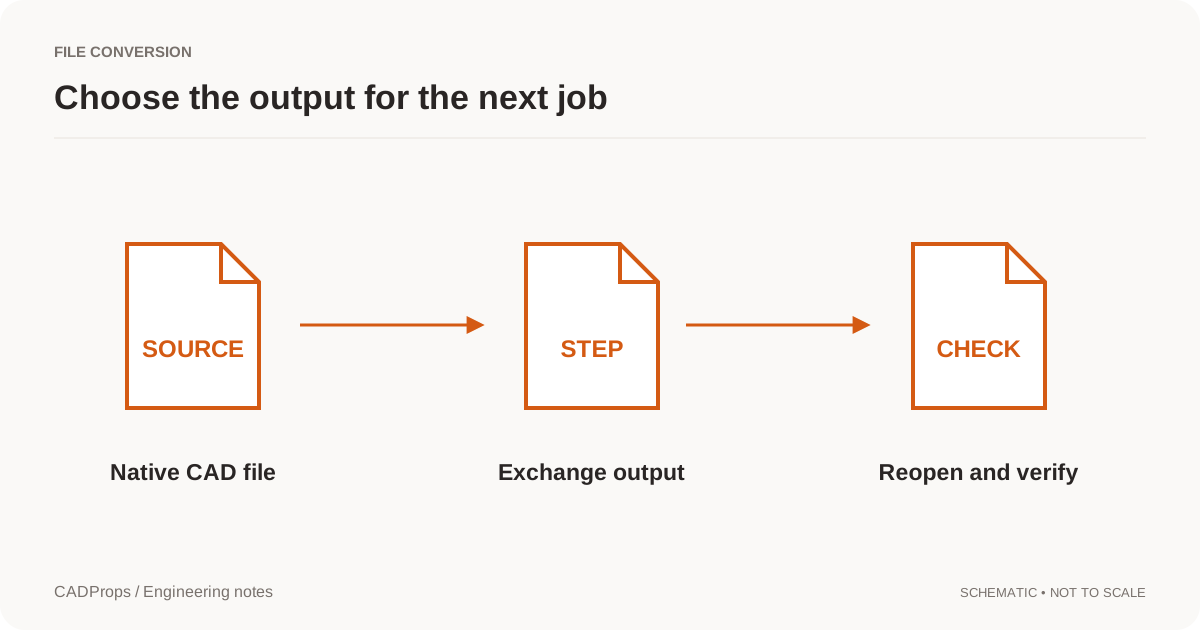
Choose the route by the task: use the Inventor viewer for inspection, request a STEP export for an agreed exchange workflow, or use a compatible authoring application when you need to change the original features and constraints.
Identify IPT, IAM and drawing files
An .ipt is an Inventor part; an .iam is an assembly that may reference IPT files and nested assemblies. An Inventor drawing is a separate document. Do not rename IAM, IDW or DWG to IPT to make an upload accept it.
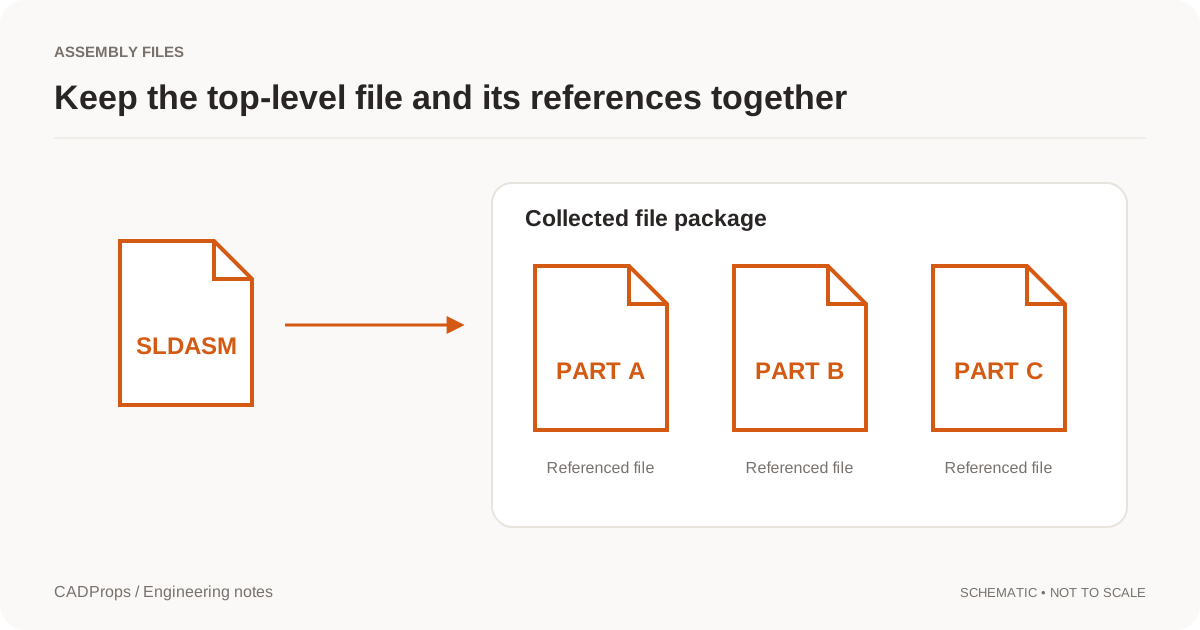
For an IAM assembly, ask the sender for a collected package containing its local dependencies. Keep the original relative folder structure in a ZIP. If several top-level models are possible, select the intended root when prompted. Missing references may leave a partial model; an isolated assembly document is not evidence that all its parts are present.
Open an IPT in your browser
- Visit the Inventor viewer. Review the current upload size and retention limits. Selecting a file uploads it to the server, so check that you may share it with this service.
- Click Choose file and select the
.ipt. For an assembly, select its complete ZIP instead. - Wait for processing. Once geometry appears, use Fit and drag to inspect the shape. Compare it with the sender's expected revision and configuration.
- Check X, Y and Z extents and units in Properties. Use Measure for a known dimension. Check the loaded structure for missing or unexpected bodies.
- Confirm the material density before interpreting calculated mass. Geometry volume and a selected density do not prove the original material specification.
- Use Convert to select STEP if you need a downloadable exchange file. Reopen the download in the receiving application; successful display alone is not a manufacturing approval.
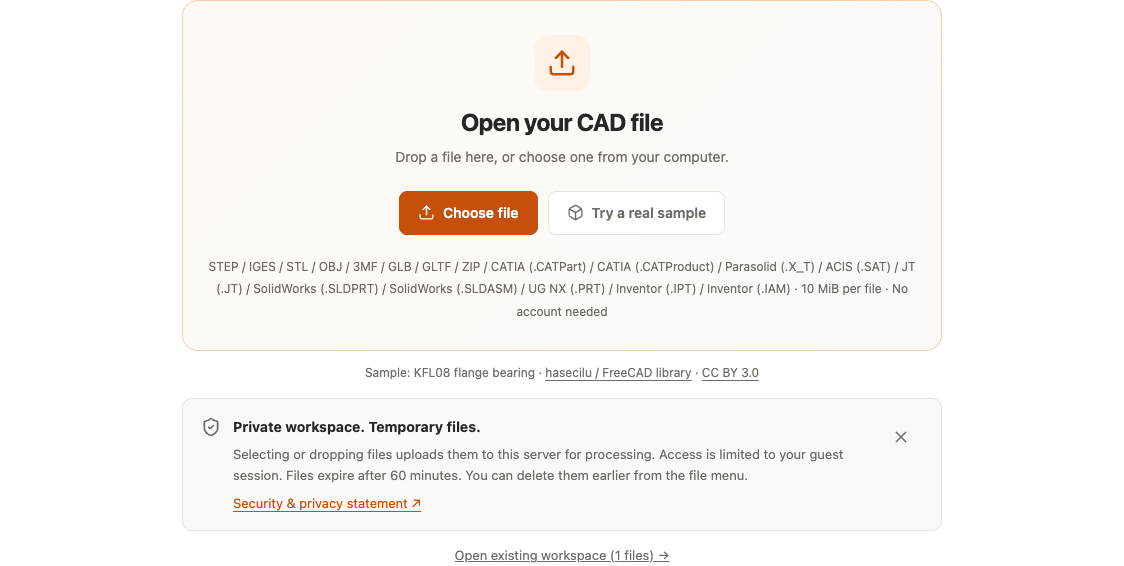
The actual Inventor tool upload screen. Try a real sample opens the site's STEP bearing example, not an IPT. Use Choose file to exercise native Inventor input.
A repeatable inspection exercise
Use a non-confidential part with one dimension you already know from the sender or its drawing. Record the expected units, revision and number of bodies before uploading. Then compare the loaded result in this order: overall shape, body count, units, one known dimension and only then volume or mass.
For a public reader-test example, the InventorLoader Demo-Status-0.4.ipt was used in CADProps' IPT acceptance checks. Download from the source and consult its repository license before redistributing it. It tests a particular file, not every Inventor release or feature. The earlier 0.1 demonstration file did not produce readable solid geometry in our checks; a familiar extension alone is not a compatibility test.
If your known dimension does not agree, stop before exporting or estimating material weight. Confirm that you received the intended part and that the sender's dimension refers to the same axes or features. Matching the overall bounding box does not verify every hole, face or tolerance.
Troubleshoot the failure instead of changing the extension
| What happened | Next action |
|---|---|
| The upload is rejected | Check the extension and displayed size limit. CADProps does not accept Inventor drawings as IPT geometry. |
| A valid-looking IPT fails processing | Ask which Inventor release saved it, request a fresh file and, if necessary, a STEP export. Not all native versions have been verified. |
| An IAM shows only some parts | Read the missing-component warning. Request the absent dependencies and upload the corrected ZIP. |
| Several assembly roots appear | Choose the intended top-level IAM; do not assume the first file is the complete product. |
| Volume is unavailable | Check whether readable closed solids were loaded. A visible surface does not necessarily enclose a volume. |
| A feature tree is missing | Browser geometry and an assembly structure are not the original Inventor sketches, constraints and feature history. |
A partial assembly's properties describe loaded components only. Do not use that mass as the mass of the complete assembly. If nothing usable was loaded, ask for a new export rather than trusting a thumbnail.
Ask the sender for the right handoff
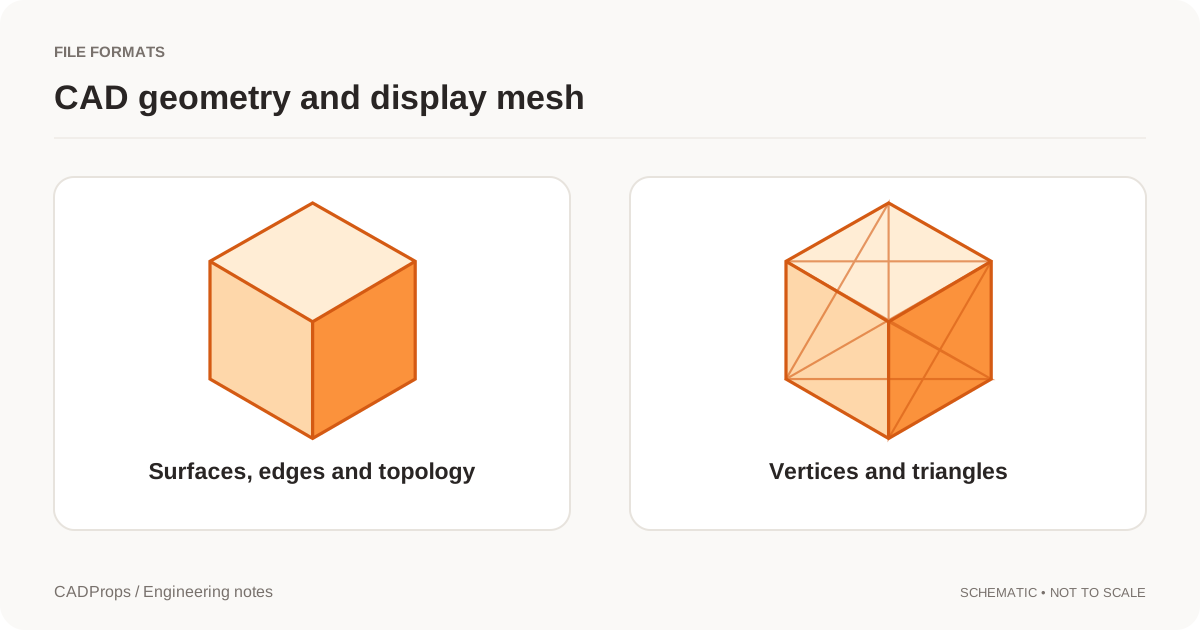
Request “the intended part or complete assembly as STEP, with units and revision confirmed, plus the native files if we need parametric edits.” For assembly exchange, agree whether separate components and their placements must be retained. Read why STEP does not preserve the original feature tree and the conversion checklist before approving a converted deliverable.
Open an IPT file when the input and expected result are clear.