

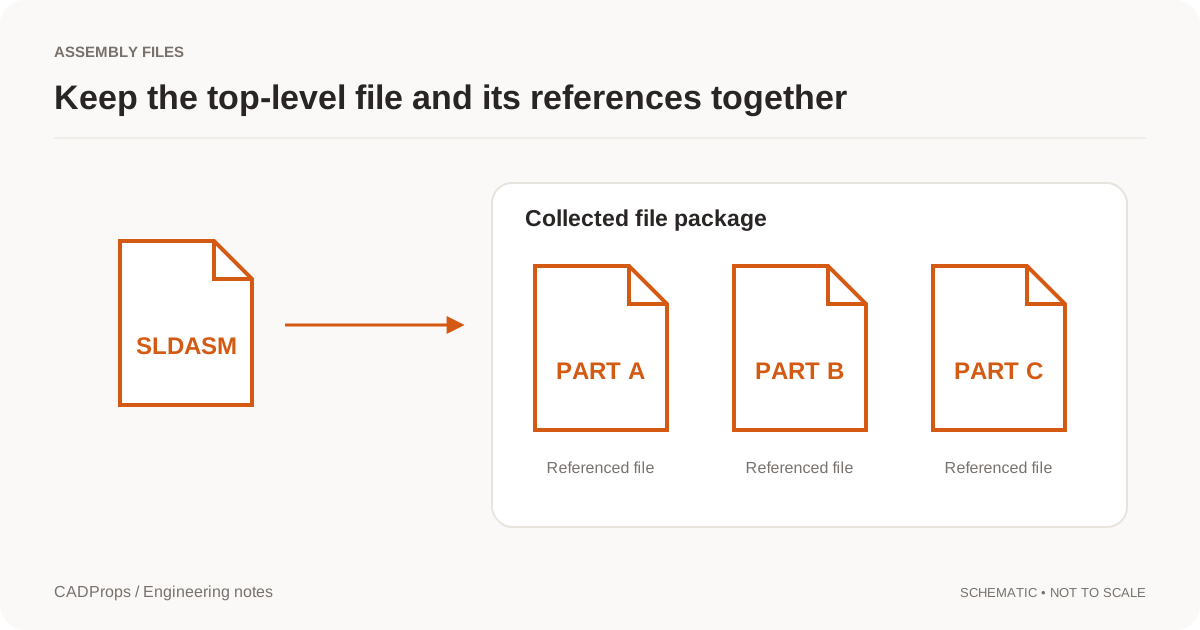
An Inventor .iam file is an assembly document. It can reference many .ipt parts and nested assemblies, so an IAM sent by itself may not contain enough information for another system to reconstruct the complete product.
CADProps supports tested Autodesk Inventor IPT/IAM inputs for browser viewing and STEP conversion. For assemblies, package the IAM with its referenced components and preserve the relative folder layout in a ZIP. That makes missing dependencies explicit instead of silently treating a partial model as complete.
Use the Inventor viewer when your goal is inspection. Use Autodesk Inventor or another compatible authoring workflow when you need to edit constraints, features or the original design structure.
IAM and IPT are different handoff problems
An IPT normally represents an Inventor part. An IAM represents an assembly and commonly depends on external files. If you received a single IPT, follow how to open IPT without Inventor.
If you received an IAM, ask these questions first:
- Is this the intended top-level assembly?
- Are all referenced IPT and nested assembly files included?
- Were the files collected from the same released revision?
- Are Content Center or other library components required?
- Are the expected units known?
Do not rename an IAM to IPT or STEP. File extensions label formats; they do not perform conversion.
Package the assembly before viewing it
The safest package keeps the root IAM and all required local references in their original relative locations. If the sender can create a collected project package from Inventor, use that output. Otherwise, ask for a ZIP that contains the complete dependency set.
When multiple IAM files exist in the package, identify which one is the product-level root. A subassembly can look complete on screen while representing only one section of the machine.
CADProps reports missing components when the native package cannot resolve every reference it expects. Treat that warning as part of the engineering result.
Open an IAM assembly online
- Open the Autodesk Inventor viewer.
- Upload the complete ZIP package rather than an isolated IAM when external references are involved.
- Select the intended assembly root if more than one candidate is present.
- Wait for processing, then inspect the component tree and overall model before measuring.
- Check X, Y and Z dimensions and source units.
- Measure a known feature from the drawing or sender.
- Review missing-component warnings before using volume or mass.
- If the receiver needs a neutral CAD file, use the Inventor to STEP converter and verify the download independently.
The browser view is useful for geometry review. It does not reproduce the entire Inventor project environment or feature history.
Why missing components matter to CAD properties
A partial assembly can still produce dimensions, volume and a calculated mass. Those numbers are properties of the geometry that actually loaded.
For example, if a gearbox housing loads but its motor and fasteners are missing, the overall bounding box may still look close to the final product. The calculated volume and mass will nevertheless be incomplete.
Use the following order:
- confirm the root IAM;
- check component completeness;
- confirm units;
- compare a known dimension;
- only then interpret area, volume or density-based mass.
If any component is missing, record that limitation with the measurement rather than presenting the number as an assembly total.
Troubleshoot an IAM that will not open
| Problem | Next step |
|---|---|
| Root IAM is present but parts are missing | Request the referenced IPT and nested assembly files |
| Several possible roots are shown | Confirm the intended top-level IAM with the sender |
| File version appears unsupported | Ask which Inventor release saved it and request a fresh STEP export |
| Model scale is implausible | Confirm units and compare one trusted dimension |
| Volume is unavailable | Check whether the loaded geometry contains suitable closed solids |
| STEP export loses editable features | That is expected for a neutral geometry handoff; retain the native files for design edits |
If the source package is not complete, do not waste time repeatedly converting the same partial assembly. Fix the handoff first.
Use STEP for cross-CAD exchange
STEP is often a better deliverable when the recipient does not use Inventor and needs geometry rather than native editing. Before approving the converted file, compare the STEP result against the source assembly or drawing.
Check overall dimensions, component count where available, orientation and a few important interfaces such as mounting faces and holes. The CAD conversion checklist provides a repeatable review sequence.
For supplier communication, include the revision and controlling drawing or specification. The supplier handoff guide explains why a model link or file alone is not enough context.
Open an IAM assembly when the package contains the dependencies you expect.
Original article: CADProps · https://www.cadprops.com/guides/open-iam-without-inventor/