

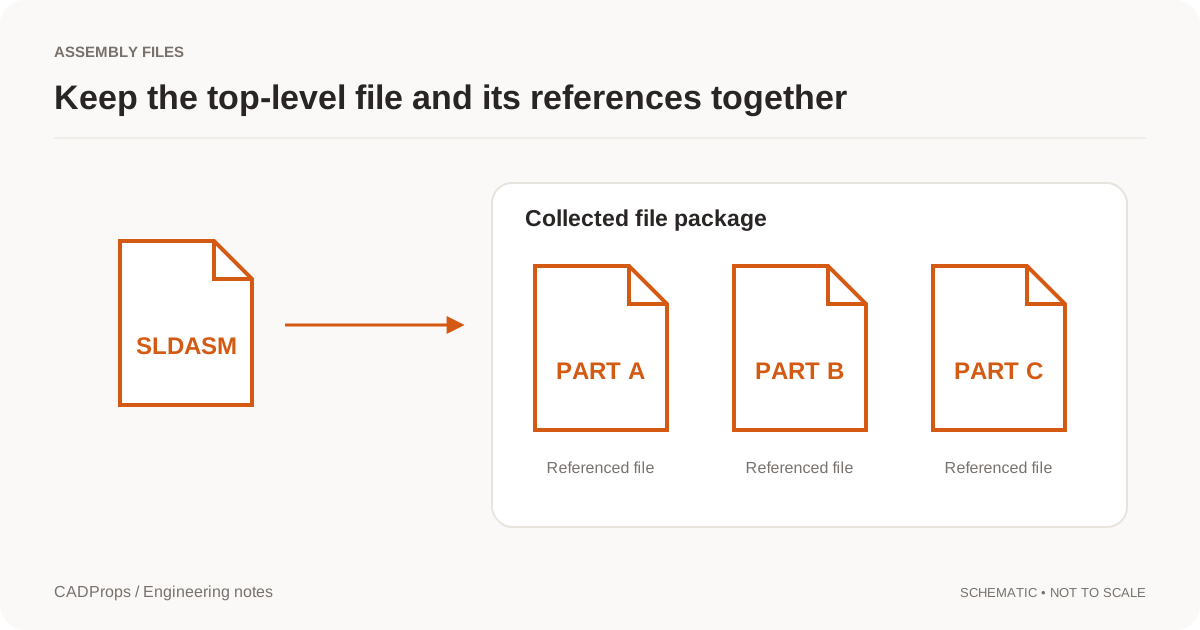
A .CATProduct file is a CATIA assembly document. It can reference separate .CATPart files and other assembly content, so the top-level file alone is often not enough for a complete handoff.
CADProps supports tested CATIA V5 CATPart and CATProduct packages for browser viewing and STEP conversion. For assemblies, include the CATProduct and all required CATPart files together in a ZIP while preserving their relative paths. If some dependencies are absent, the result may be partial and should be treated that way.
Use the CATIA viewer for inspection. Use CATIA or another compatible authoring workflow when you need to edit the original product structure, features or constraints.
CATProduct versus CATPart
A CATPart is a part document. A CATProduct is used to organize an assembly and references its components. The distinction matters because a standalone part is much more likely to be self-contained than an assembly root.
If you only received a CATPart, start with how to open CATPart without CATIA. If you received CATProduct plus a directory full of CATPart files, keep that structure together.
Do not rename CATProduct to CATPart or STEP. Renaming does not transform the data and can make troubleshooting harder.
Prepare a complete CATIA package
Before uploading, identify the intended top-level CATProduct and collect its dependencies. A useful assembly package should answer three questions:
- Which CATProduct is the root?
- Are all referenced CATPart files present?
- Does the package correspond to one known revision?
If the sender has provided several folders, avoid flattening everything into one directory unless the source structure was already flat. Duplicate part names and relative references can make a flattened package ambiguous.
CADProps accepts supported CATIA assembly packages as ZIP inputs. Missing components produce warnings; properties then describe loaded geometry only.
Open a CATProduct in your browser
- Open the CATIA viewer and review the current upload size and retention information.
- Upload the ZIP containing the root CATProduct and required CATPart files.
- Select the intended root if multiple top-level candidates are detected.
- Inspect the assembly tree and look for missing-component warnings.
- Confirm units and overall X, Y and Z dimensions.
- Measure one feature you already know from the drawing or sender.
- Only after completeness is confirmed should you rely on volume or density-based mass.
- If you need a neutral deliverable, use the CATIA to STEP converter and reopen the output in the destination CAD system.
A successful browser view confirms that readable geometry was loaded. It does not reproduce CATIA's entire parametric design environment.
How to recognize an incomplete assembly
Incomplete assemblies are dangerous because the visible portion can still look convincing.
Look for these signals:
| Signal | Why it matters |
|---|---|
| Missing-component warning | One or more referenced files were not resolved |
| Fewer components than expected | The package may be a subassembly or partial release |
| Unexpected empty regions | A referenced component may be absent |
| Mass is much lower than expected | Loaded geometry may be incomplete, or density may be wrong |
| Bounding box still looks plausible | Overall dimensions alone cannot prove completeness |
If you know the expected component count or one key dimension, use it as a quick sanity check.
When a CATProduct fails to process
First confirm that the file really came from CATIA V5 and that the package contains the referenced parts. CADProps does not treat every CATIA-related extension as equivalent. CGR, CATShape and 3DXML have different roles and are not enabled as substitutes for a CATProduct package in the current release.
If a valid-looking CATProduct still fails, ask which CATIA release saved it and request a STEP export from the intended revision. Native-format compatibility can depend on file version and geometry.
If a conversion creates output but the output does not reopen cleanly, treat that as a failed validation rather than a successful delivery.
STEP is often the practical supplier format
When the recipient does not use CATIA, STEP can be a simpler geometry handoff. Keep the native CATProduct/CATPart package for traceability and use STEP for cross-CAD consumption.
Before release, compare:
- overall dimensions;
- expected bodies or components;
- orientation and placement;
- important mating or mounting geometry;
- one or more known dimensions.
The conversion checklist provides a compact review process. For external manufacturing or quoting, also keep the drawing, revision and specification context with the model. See the supplier handoff guide.
Open a CATProduct assembly after you have collected the parts it depends on.
Original article: CADProps · https://www.cadprops.com/guides/open-catproduct-without-catia/