

The best supplier handoff format depends on what the supplier must do next. Native CAD is richer when both sides use a compatible authoring system and need design intent, configurations or assembly relationships. STEP is usually easier when the goal is neutral geometry exchange across different CAD/CAM systems.
The wrong question is "which format contains more data?" The useful question is which information does the recipient need, and which file can both sides validate reliably?
Send STEP when neutral geometry is the main requirement
STEP is a strong default for machining quotes, CAM preparation and cross-platform geometry review because it is designed for product-data exchange rather than one vendor's authoring environment.
A healthy STEP handoff can preserve precise B-Rep geometry, product structure and, in modern AP242 workflows, selected product and manufacturing information. NIST's STEP tools analyze parts, assemblies, PMI and validation properties. NIST STEP File Analyzer.
But STEP is not a magic copy of the native model. A neutral export normally does not recreate the original feature history, mates, design tables or CAD-specific editing intent. The feature-tree guide explains that boundary.
For a machining supplier, that loss may be acceptable because the shop mainly needs reliable nominal geometry plus the controlled manufacturing requirements.
Send native CAD when editability or authoring context matters
Native files are usually more appropriate when the recipient must:
- continue editing the design in the same CAD system;
- inspect configurations or design-table variants;
- understand feature history or modeling intent;
- work with native mates, parameters or application-specific objects;
- update an assembly while preserving native references.
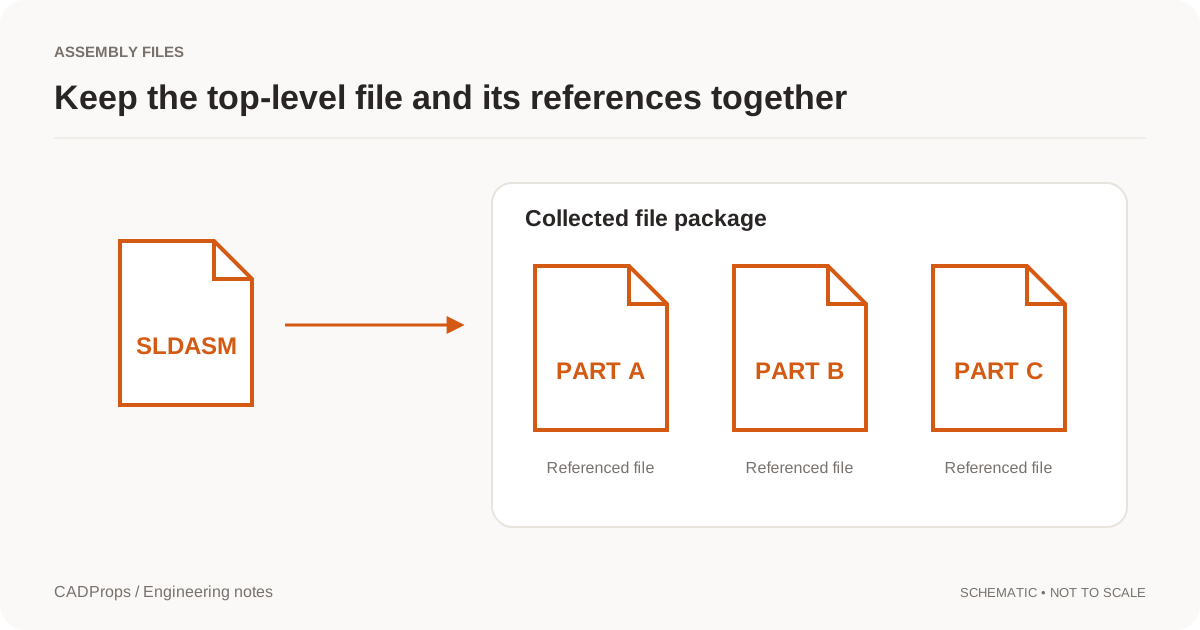
Native assemblies often depend on other files. Sending only the top-level assembly can create a clean filename with missing geometry at the receiver. A collecting workflow such as SOLIDWORKS Pack and Go is designed to gather referenced design files. SOLIDWORKS Pack and Go.
If you send native CAD, treat the dependency package as part of the deliverable.
Send both when the jobs are different
There are many cases where "native or STEP" is a false choice.
A supplier doing collaborative design may need native CAD, while manufacturing or quality teams want a neutral STEP snapshot tied to the released revision. Sending both can work well when you label their roles clearly.
For example:
| File | Role |
|---|---|
HOUSING_REV-C.sldprt |
Editable source for agreed SolidWorks collaboration |
HOUSING_REV-C.step |
Neutral released geometry for CAM and independent checking |
HOUSING_REV-C.pdf |
Controlled drawing when tolerances/notes live there |
The important part is that all three identify the same revision and configuration.
Do not send several unlabeled alternatives and expect the supplier to decide which one controls production.
Use the recipient's task as the decision rule
| Supplier task | Usually prefer | Why |
|---|---|---|
| CNC quote or CAM in a different CAD/CAM stack | STEP + drawing/PMI requirements | Neutral solid geometry is easier to consume |
| Same-CAD co-design | Native CAD package | Feature history and application-specific relationships may matter |
| Assembly edit with native references | Native package, often plus STEP snapshot | Dependencies and editability matter |
| Independent geometry review | STEP | Easier to reopen outside the authoring tool |
| Browser-only visual review | Lightweight preview plus engineering source | A preview should not silently replace the source |
| Validated model-based definition | Agreed AP242/MBD workflow | PMI semantics must be tested end to end |
A format decision should be tied to a task, not a habit.
STEP can carry more than geometry, but validate the workflow
Modern STEP AP242 can carry richer product definition than the old stereotype of "dumb geometry." SOLIDWORKS documents STEP 242 workflows that can include 3D PMI and selected custom properties. SOLIDWORKS STEP242 sharing.
That capability does not mean every exporter, importer and downstream CAM/CMM application preserves or interprets the same information. If PMI matters, test the actual authoring-to-receiving chain instead of assuming the extension guarantees semantic fidelity.
For ordinary supplier email handoffs, it is still common to pair STEP geometry with a drawing or other controlled specification.
Consider intellectual property separately
Exporting to STEP usually removes native feature history, but that does not make the file harmless from an IP perspective. The exact product geometry, assembly structure, names or embedded metadata may still be sensitive.
Do not use "STEP hides the feature tree" as a substitute for a data-sharing policy. Send only the scope the supplier needs and use the organization's approved transfer route.
Likewise, native CAD may expose more editable design intent than necessary for a quote. That can be a reason to prefer a neutral exchange file when the supplier does not need the authoring model.
Validate whichever handoff you choose
For STEP:
- reopen the actual exported file;
- confirm revision/configuration;
- verify one known dimension and units;
- confirm expected bodies/components and placements;
- check whether required PMI or metadata survived when it matters.
For native CAD:
- collect referenced files;
- confirm the intended configuration;
- test the package in a clean location or receiving environment;
- make unresolved references visible;
- state the CAD version when compatibility matters.
The CAD conversion checklist provides a more detailed neutral-file acceptance workflow.
CADProps scope
CADProps can help independently open supported STEP/native-derived geometry, inspect dimensions and loaded scope, and compare supported 3D versions. It is not a PLM system and it does not restore a neutral STEP file into the original parametric feature history.
Use the supplier handoff checklist to record revision, intended use and exclusions.
A good handoff is not the one with the most files. It is the one in which the recipient knows which file is authoritative for their task, what revision it represents and what information still lives outside that file.
Original article: CADProps · https://www.cadprops.com/guides/native-cad-vs-step-supplier-handoff/