

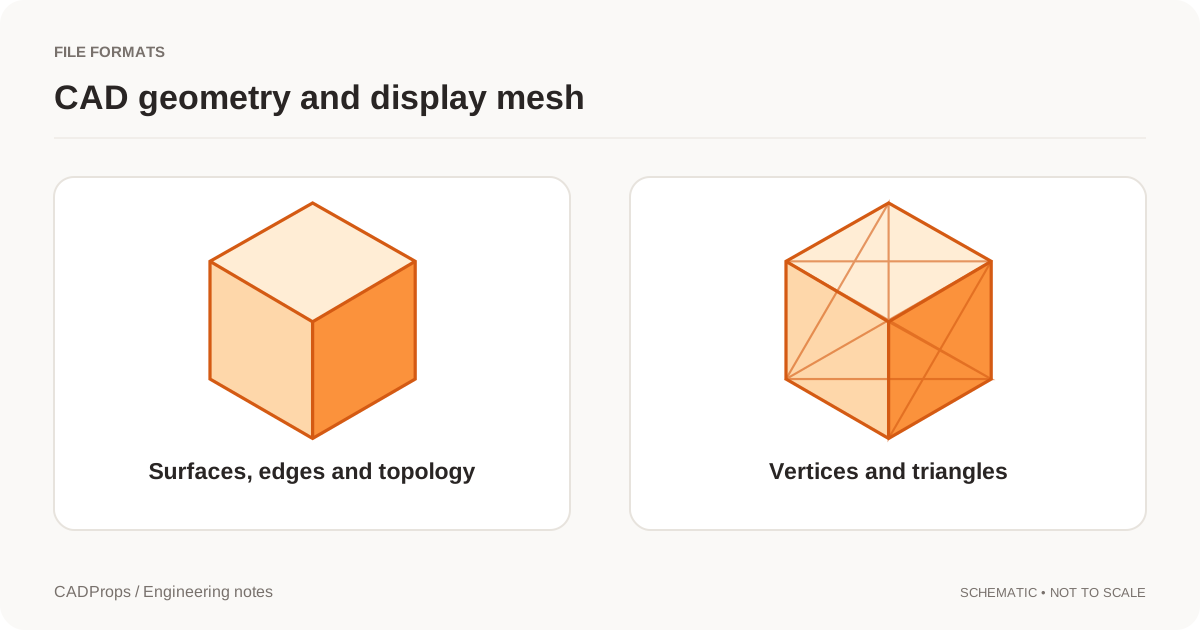
STL and 3MF can both carry triangle-mesh geometry, but they solve different handoff problems. STL is simple and extremely common. 3MF is a packaged, structured format designed for additive-manufacturing data and can declare information that STL does not standardize, including physical units and multiple objects.
The 3MF Consortium describes 3MF as an XML-based format carried in a ZIP container and notes that its core specification defines units, geometry, transforms and metadata. 3MF Consortium format overview provides the specification context.
For CADProps, the practical boundary is narrower than the full 3MF ecosystem: the 3MF viewer currently inspects core triangle geometry, declared units and repeated component instances. Manufacturing extensions are not interpreted, and reported geometry properties are mesh approximations. The STL viewer inspects STL mesh geometry, but STL does not reliably declare its physical unit.
3MF and STL at a glance
| Question | STL | 3MF |
|---|---|---|
| Core geometry | Triangle mesh | Triangle mesh in structured package |
| Standard physical unit declaration | No reliable unit field | Yes, units are defined by the format |
| Multiple named/instanced objects | Not a standardized scene/package model | Supported by the 3MF object/build structure |
| Package/container | No | ZIP-based package |
| Materials, colors and richer AM data | Not standardized in the core STL workflow | Available through 3MF core/properties/extensions depending on data |
| CADProps properties | Mesh approximations | Mesh approximations |
| CADProps manufacturing extensions | Not applicable | Not interpreted in the current release |
The table is about format capability, not a guarantee that every application writes or reads every optional 3MF feature.
The biggest day-to-day difference is units
An STL coordinate value does not reliably say whether it represents millimeters, inches or another physical unit. The receiving application has to know the convention. That is why STL handoffs commonly suffer from 25.4× scale mistakes between inch and millimeter workflows.
3MF defines a model unit, which makes the intended physical scale explicit. That does not prove the model was authored at the correct size, but it removes one ambiguity that STL leaves to the workflow.
If an STL arrives at the wrong size, read do STL files have units? before applying a scale factor.
3MF is more than “STL inside a ZIP”
It is tempting to describe 3MF as a compressed STL, but that misses the structure that makes the format useful. A 3MF package can describe objects, reusable components and transforms instead of treating the delivery as one anonymous triangle stream.
That matters for a build containing repeated parts. A structured format can refer to a component and place instances through transforms. It also gives software a defined place for metadata and additional manufacturing information.
CADProps currently focuses on the core geometry needed for inspection. It can read the declared unit and repeated component instances that are part of the supported core workflow, but it does not claim to reproduce every manufacturing extension, slicer setting, texture or printer-specific project feature that may be stored in a 3MF produced by another application.
STL still has a compatibility advantage
STL remains useful because nearly every mesh-oriented tool understands it. If the recipient only needs one static triangle mesh and both sides have already agreed on units, STL can be the lowest-friction handoff.
That simplicity can also be an advantage when debugging: fewer layers of package structure mean fewer dependencies to inspect. But the tradeoff is that important context has to travel outside the file.
Use STL deliberately when:
- the receiving tool expects STL;
- one mesh is sufficient;
- unit convention is explicitly agreed and verified;
- material, object structure and richer metadata are unnecessary.
Use 3MF deliberately when:
- preserving an explicit unit is valuable;
- multiple objects or instances need a structured package;
- the receiving additive workflow understands the relevant 3MF capabilities;
- you want room for metadata or supported manufacturing extensions.
Neither format restores CAD design history
Both STL and the mesh geometry in 3MF are downstream representations. They do not recreate the sketches, constraints, parametric features and design intent of the original SolidWorks, NX, Inventor, CATIA or other native CAD model.
If the recipient needs precise B-rep solids for machining, editing or measurement against analytic surfaces, a STEP or native CAD handoff may be more appropriate. STEP versus STL explains that boundary.
A format with more metadata is not automatically a better engineering master file. Choose the format for the receiving task.
Compare the same exported part before standardizing on a format
A practical evaluation uses one known model and exports both formats from the same source revision.
Check:
- overall dimensions after import;
- the intended physical unit;
- number of expected objects/components;
- visible mesh quality around curved and small features;
- whether the receiving software preserves the information the job actually needs;
- whether file size and processing time are acceptable for the real models you exchange.
Do not judge only by thumbnail appearance. Both files can render smoothly while differing in scale, object structure or metadata.
CADProps-specific 3MF limits to keep visible
The public 3MF workflow currently supports core mesh geometry with declared units and repeated component instances. Packages are bounded for safe processing, and manufacturing extensions are not interpreted. Properties such as area and volume are calculated from the loaded mesh and should be treated as approximations.
That means CADProps is appropriate for checking whether the core geometry and scale look right. It is not a validator for every color, material, printer setting or extension that a full additive-manufacturing application may place in the package.
Likewise, the STL path is a geometry inspection workflow. It cannot recover a physical unit that the source file never standardized.
Which one should you send?
For a simple mesh-only receiver, send the format the receiving software handles reliably and include the intended unit. If both are supported and preserving explicit scale/object structure matters, 3MF is usually the more informative container.
For a machining or CAD-to-CAD workflow, ask a different question first: does the receiver actually want a mesh? If not, keep the native model and consider STEP rather than choosing between two mesh formats.
Before exporting STL, use the STL export settings guide to record tessellation and unit assumptions. To inspect an incoming package, open the 3MF online or measure the STL and verify one known dimension.
Original article: CADProps · https://www.cadprops.com/guides/3mf-vs-stl/