

An .x_t file contains Parasolid exchange data used by many mechanical CAD systems. If you receive one and only need to inspect the geometry, you may not need the original authoring application. A compatible Parasolid reader can display the model, measure it and convert readable solid geometry to another exchange format.
CADProps supports tested X_T inputs for browser viewing and STEP conversion. The current public support is for the text-based X_T path. X_B is a different Parasolid representation and is not enabled in CADProps, so do not rename .x_b to .x_t.
Use the Parasolid X_T viewer when the job is inspection.
What an X_T file is useful for
Parasolid is a geometric modeling kernel used inside multiple CAD products. X_T is commonly used as a history-free exchange representation of Parasolid geometry. That makes it useful when two systems need to exchange accurate model shape without sharing the original application's feature tree.
This distinction matters. Opening an X_T successfully can give you bodies, faces and measurable geometry, but it does not recreate the sketches, parameters, mates or manufacturing setup from the source CAD system.
Read Parasolid versus STEP if you are deciding which neutral format to request.
Open an X_T file online
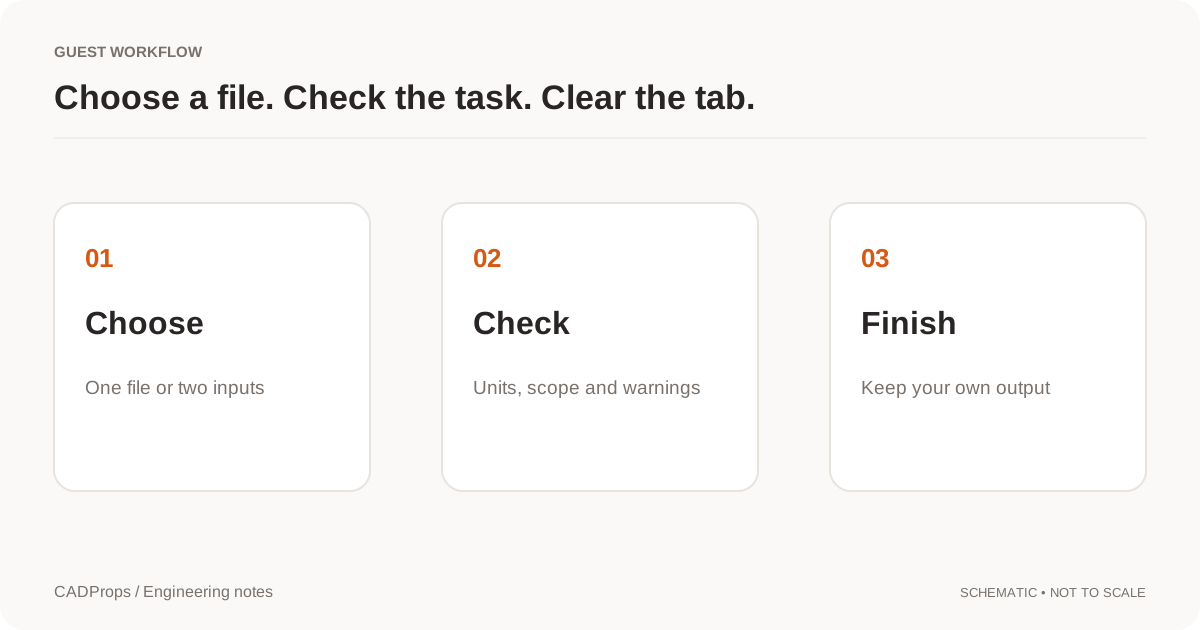
- Open the Parasolid X_T viewer.
- Select the original
.x_tfile without changing its extension. - Wait for the geometry to process, then use Fit and rotate the model.
- Check source units and overall X, Y and Z dimensions.
- Measure one dimension that you already know from the drawing or sender.
- Review body count, surface area and volume only after confirming that the expected solids loaded.
- If another CAD system needs the model, use the X_T to STEP converter and validate the STEP output in that receiving system.
A rendered model is a useful first check, not a manufacturing sign-off.
X_T and X_B are not interchangeable extensions
X_T and X_B are both associated with Parasolid exchange, but they use different representations. Changing the filename extension does not convert one into the other.
If you received X_B and your current workflow only accepts X_T, ask the sender to export X_T or STEP from the source system. That is safer than relying on a generic file rename or an unverified conversion path.
The same rule applies when somebody sends a file whose extension was changed manually. Keep an untouched copy of the original so that troubleshooting is based on the real source data.
Check units before using CAD properties
Overall dimensions are one of the fastest ways to detect a bad import assumption. Compare the reported size with a value from the drawing, purchase specification or sender.
After the scale is plausible, inspect solid properties. A volume requires suitable closed geometry. If the file contains surfaces or invalid/open bodies, a viewer may still display them while a trustworthy solid volume remains unavailable.
Any calculated mass also depends on the density you choose. It is not material metadata automatically certified by the X_T file.
Why an X_T file may fail to open
| Symptom | Likely next check |
|---|---|
| Upload rejects the extension | Confirm that the file is X_T, not X_B or a renamed native file |
| Reader fails on a recent export | Ask which Parasolid/CAD release created it and request another export |
| Model appears at the wrong scale | Confirm units and compare a known dimension |
| Surfaces display but volume is missing | Check whether the model contains valid closed solids |
| STEP conversion differs | Compare bodies, dimensions and orientation in the destination system |
| Editable feature history is missing | X_T is a geometry exchange path, not the source feature tree |
When the issue is version compatibility, the best fix is usually at the source: create an agreed exchange file from the original CAD system rather than chaining uncertain conversions.
When STEP is the better downstream format
X_T is attractive when both sides have strong Parasolid support. STEP is often chosen when the downstream toolchain is more heterogeneous.
If you convert X_T to STEP, preserve the original X_T alongside the output and record the source revision. Then reopen the STEP file and verify important geometry. The CAD conversion checklist explains the minimum checks.
Also read why STEP does not preserve the original feature tree if somebody expects a neutral export to behave like the authoring model.
Open an X_T file online when you need to inspect readable Parasolid geometry without installing a full CAD system.
Original article: CADProps · https://www.cadprops.com/guides/open-x-t-file-online/