

A .sat file is an ACIS geometry file. If you only need to inspect a part, confirm its size or create a neutral STEP handoff, you do not necessarily need the CAD application that originally exported it. A reader that understands the file's ACIS geometry can be enough for that narrower job.
CADProps currently accepts text SAT files with readable solid geometry. It can display the converted geometry, report dimensions and solid properties, and produce STEP output for supported inputs. Binary .sab is a different encoding and is not enabled in the current CADProps workflow. Do not rename SAB to SAT to bypass that distinction.
Spatial, the company behind ACIS, describes SAT as the text representation of ACIS model data and SAB as its binary counterpart. SAT can carry exact solid and surface geometry rather than only a triangle mesh. Spatial's SAT format overview is useful background when you need to distinguish the formats.
Open a SAT file in the browser
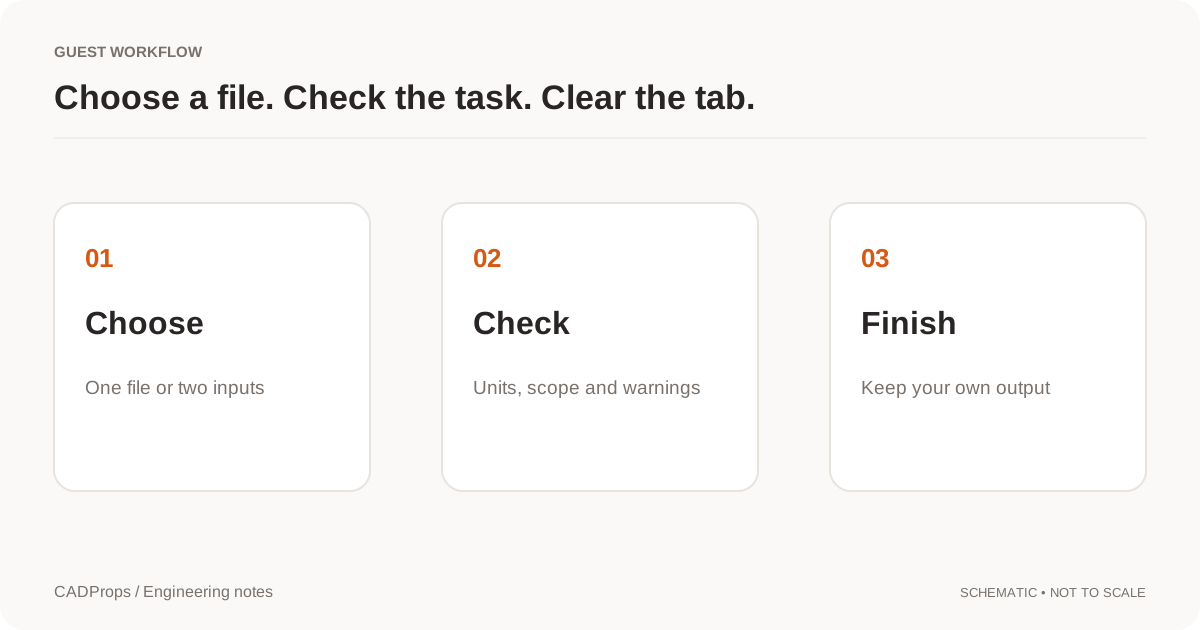
- Open the ACIS SAT viewer.
- Select the original
.satfile. Keep an untouched copy rather than resaving it before the first test. - Wait for processing and use Fit to bring the model into view.
- Confirm the number of loaded solids and compare the overall X, Y and Z dimensions with a trusted value.
- Measure at least one known feature before relying on area, volume or a converted file.
- If you need a neutral deliverable, create the available STEP output and reopen that STEP in the application that will actually use it.
Successful display is a compatibility check, not a manufacturing approval. Keep the drawing, revision and material specification alongside the model when those documents control the job.
SAT versus SAB: check the encoding before troubleshooting
The similar names cause avoidable confusion:
| File | Typical representation | CADProps status |
|---|---|---|
| SAT | ACIS text representation | Supported for validated readable geometry |
| SAB | ACIS binary representation | Not enabled in the current release |
Changing .sab to .sat changes only the filename. It does not convert binary data into the SAT text representation. If the sender supplied SAB, ask them to export SAT or STEP from the source application.
The same rule applies to any file whose extension was changed manually. A parser failure after a rename does not prove the underlying geometry is damaged; it may simply be the wrong format for the selected reader.
Check units with a known dimension
Do not infer physical size from how large the model looks in the viewport. A viewer can fit a tiny component and a machine frame into the same screen area.
Instead, choose a dimension you know independently: a drawing dimension, a supplier specification or a value from the authoring system. Compare that value with the loaded model before doing anything else downstream.
A useful check sequence is:
- expected part or assembly revision;
- solid/body count;
- overall X, Y and Z extents;
- one known linear dimension;
- only then surface area, volume and any density-based mass calculation.
If the scale is wrong, investigate the source/export and receiving-unit assumptions first. Do not apply an arbitrary visual scale until the mismatch has been explained.
Why a SAT file can display but still need validation
A readable 3D picture answers only one question: some geometry was interpreted. It does not tell you that every engineering detail required for the downstream task survived.
Check for these cases:
- Open or sheet geometry. A surface can be visible without enclosing a valid volume.
- Unexpected body count. Extra construction bodies or missing solids can change calculated properties.
- Version compatibility. ACIS-based exchange still depends on what the receiving reader supports.
- Tolerance or healing changes. A translation may repair or reinterpret problematic geometry rather than preserve it byte-for-byte.
- Lost source history. A geometry exchange does not recreate the original sketches, constraints or feature tree.
If volume is unavailable, do not manufacture a mass estimate from a bounding box. First confirm whether the input actually contains closed solids suitable for that calculation.
SAT to STEP: verify the result, not just the download
STEP is useful when the recipient does not have an ACIS-native workflow. The important part is not that a converter generated a .step file; it is that the result reopens with the expected geometry.
After conversion, compare:
| Check | Why it matters |
|---|---|
| Solid/body count | Detect missing or unexpectedly merged geometry |
| Overall dimensions | Catch scale or transform problems |
| One or more known features | Verify more than the bounding box |
| Orientation | Avoid handing off a rotated or displaced model unexpectedly |
| Volume where applicable | Catch major solid-geometry changes |
Use the CAD conversion checklist for a more complete handoff review. If somebody expects the neutral output to contain the source CAD feature history, read why STEP does not preserve the original feature tree.
When to ask the sender for another file
Ask for a fresh export rather than repeatedly translating the same questionable file when:
- the file is actually SAB;
- the SAT version is not readable in the receiving workflow;
- the expected solid is missing or incomplete;
- known dimensions disagree after the unit assumptions are checked;
- the downstream application needs source features rather than exchange geometry.
A practical request is: “Please export the released model as SAT or STEP, confirm the units and revision, and keep the native design file available if editable history is required.” For supplier work, include the same revision context described in the CAD supplier handoff guide.
Open a SAT file online when you need to inspect supported ACIS text geometry without installing a full CAD system.
Original article: CADProps · https://www.cadprops.com/guides/open-sat-file-online/